The Fredericton Botanic Garden
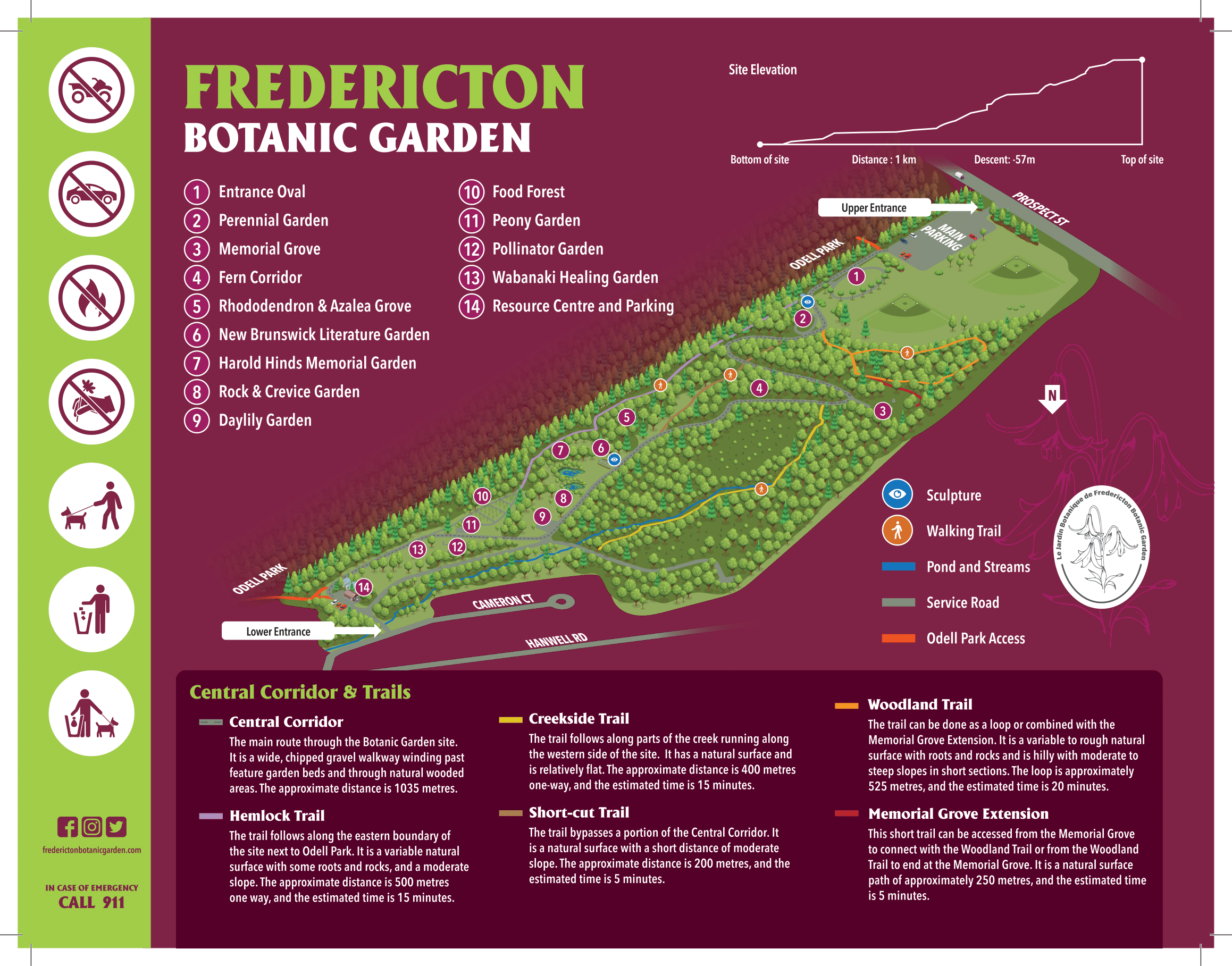
The Fredericton Botanic Garden is open to the public from dawn to dusk, 365 days a year, free of charge. The Garden can be accessed from Prospect Street (by the ball fields) or Cameron Court (off Hanwell Road), with parking available at both entrances. There are also two areas for foot access from Odell Park, one near each of the official entrances.
In addition to the Central Corridor, which runs from the bottom to the top of the Garden, there are numerous trails of varying lengths and challenges available for your enjoyment. Consult the map for more information on specific trails.
Enjoy the almost 20 individual gardens located throughout the property, designed to provide something new to see each week during the growing season. Please take nothing but photographs.
Leashed dogs, with well-trained owners, are welcome.
The Garden’s office is in the Resource Centre, at 10 Cameron Court. The Garden’s greenhouses, maintenance yard and holding beds are in the immediate vicinity of the Resource Centre. Office hours vary, so check the Contact Us page for updates.
The Resource Centre can be booked for small meetings and events. Areas of the Garden can be reserved for special occasions such as weddings, family reunions, and photography sessions. Please contact the office for information and pricing.


Our History
In 1989, inspired by their common passion for botany and horticulture, a group of residents formed the Fredericton Botanic Garden Association (FBGA), dedicated to establishing a Botanic Garden in Fredericton. One year later, in 1990, the City of Fredericton dedicated a 21-hectare (53-acre) property at the west end of Odell Park, and the Fredericton Botanic Garden was born.
Since its establishment, the Garden has evolved through the joint efforts of the members, volunteers, and donors of the FBGA and the City. The Local Improvement Association (LIA) is a partnership between the Garden and the City that consolidates the interests of the parties in the ongoing success of the site.
The FBGA is a registered non-profit charitable organization overseen by a voluntary Board of Directors and managed by a professional staff. Board Committees engage in a variety of activities including site development, membership and volunteer services, and community outreach. Committee membership is drawn from the Board and volunteers of the Garden.
Vision
Welcoming all to enjoy and to learn about the beauty and diversity of plants, gardening, and nature.
Mission
The Fredericton Botanic Garden welcomes all visitors and residents to enjoy and learn from an ever-improving collection of plantings, trails, and other displays. The Garden celebrates beauty, biodiversity, gardening practices and styles.
goals
The Garden is a community project carried out by volunteers in partnership with the City of Fredericton. Like all gardens, it is not a static display and will never be “finished”. New plantings and other elements are added as funding is available. The Garden will:
- Provide recreational opportunities for the public through garden displays of foliage and flowers, walks, interpretive trails, talks and workshops, and other events;
- Provide a contemplative space offering serenity;
- Educate visitors about gardening, plants, nature, and conservation;
- Provide demonstrations of, and advice on, gardening techniques;
- Complement other City and regional attractions in drawing visitors to the area; and
- Contribute to making Fredericton an inclusive, sustainable, and livable community
The Garden’s Design Principles
Development of the Garden is based on the following principles:
- The Garden is on unceded Wolastoqey land and works towards reconciliation.
- Access to the Garden is open and free to all.
- Accessibility to senior citizens and to persons with disabilities is considered in Garden design.
- The Garden balances the ornamental, educational, recreational, and conservation functions of a botanic garden.
- The Garden does not knowingly plant or distribute invasive alien species.
- The Garden recognizes that our climate is changing and considers the sustainability of plantings under future climate scenarios.
- The Garden celebrates its relationship with neighbouring Odell Park and seeks synergies between the two public spaces.
- The Garden seeks cooperation with community groups and institutions holding complementary goals.
The Gardens
Welcoming all to enjoy and to learn about the beauty and diversity of plants, gardening, and nature.
Bronwen’s Memorial Woodland Garden

Creating Browen’s Memorial Woodland Garden
The Fredericton Botanic Garden Association knew it wanted to respect the memory of its Board Chair, Bronwen Cunningham. A garden in her honour seemed very appropriate. In the design I was guided by both the conserver philosophy of reuse and recycle as well as what I understood about her priorities for the Garden, her spirit and the plants she loved.
Garden design is shaped by the earth, the soil, and sunlight and water conditions. It attempts to catch the spirit of Garden’s theme, in this case, a memorial. This Garden features a gradual and intentionally moody shift between shade, part shade and sun as well as use of the calming shades of green, white, purple and blue.
Plants in the Garden include those which were donated by Bronwen, from her garden, those donated in her memory, those replanted from the small garden which preceded this Garden, and new plants purchased to echo the theme.
No garden is ever finished as you see on the opposite side of the service road, where The Stumpery is under development, again following the conserver theme of reuse and recycle.
Many thanks are owed for the removal of diseased trees, drainage, rock and other construction work to Eldon Toner and Matt Furlotte. Head Gardener, Jake Cadieux and the Hort Crew also did a splendid job. I hope you all enjoy the result and find it a fitting memorial to Bronwen.
Heather Conners-Dunphy
Certified Master Gardener
The Dedication
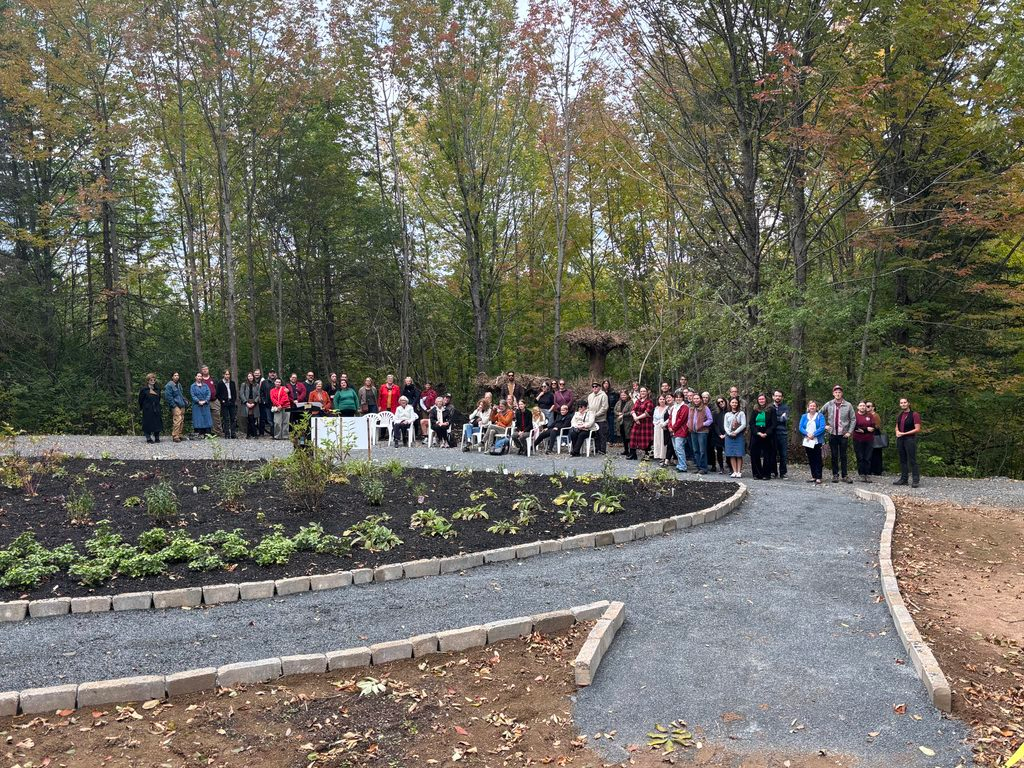
Despite weather forecasts of rain and wind, September 20, 2026, dawned temperate and sunny. It was a perfect day to dedicate Bronwen’s Memorial Woodland Garden to our late Chair, Bronwen Cunningham.
More than 60 of Bronwen’s family, friends, and colleagues, gathered at her garden, to listen to current Fredericton Botanic Garden Association Chair, Julie Wright, share her memories of Bronwen, and officially dedicate the garden. Bronwen’s brother, Neil Cunningham, expressed appreciation on behalf of the family while sharing insights into the origins of his sister’s lifelong passion for gardening.
Following the dedication, a reception was held in the Resource Centre, where stories were shared and a guest book was signed and given to Bronwen’s daughter, Clio. A conceptual watercolour, donated by Dawn Mockler, of Bronwen’s Memorial Woodland Garden, in bloom, was on display.
It was a lovely way to honour and remember a remarkable woman.
The Rose Collection
Almost since it’s establishment, in the early 1990s, there have been plans and dreams for rose in the Fredericton Botanic Garden. After all, who doesn’t like roses? And their cultural roots go deep, too – a rose by any other name, the name of the rose – even every rose has its thorn.
The incarnation of The Rose Collection, as you see it now, goes back to about 2021 or 2022, when two things happened. First, Jim Goltz and Steve Heard were talking about their desire to collect and display all the native rose species of Canada. There are about a dozen, and they don’t get the love that garden roses do.
The second was when Steve happened to encounter then Mayor, Kate Rogers, in a snowy field, near Killarney Lake. They got to chatting, and Kate asked if there were any plans for a rose garden, suggesting there might be some City funding available through the upcoming Fredericton 175+ celebrations.
The Garden submitted a funding application and ultimately received $25,000 in in-kind support from the City. Those funds resulted in quite a bit of the infrastructure that now showcases The Rose Collection. Our plan was to showcase the native roses toward the lower part of the “rose bowl,” and a selection of European heritage roses up above.
We sourced roses, we planted roses; it was all looking good! We’re grateful to colleagues at the Montreal Botanic Garden and Acadia University for donating native rose material, and to Jim and a couple of other collectors for sourcing additional plants.
What was built then didn’t look much like what you see now, though, because Mother Nature decided to intervene. Spring storms washed out much of our work, even moving the steps leading into the bowl!
We’re used to that here, actually – the Garden sits on a hillslope, the soils are shallow, and every time we change something, it alters runoff patterns and water surprises us by running through new places, in new directions. The City repaired the concrete infrastructure, first working on the ditches and culverts that move water away from the Rhododendron Garden, and into the creek. This worked really well! So now the site was protected, but we needed to rebuild and replant.
Enter Bob Osborne, of Corn Hill Nursery. Bob visited us in 2025, and Jim Goltz and Heather Connors-Dunphy toured him through the site. He did soil assessments and gave us some general advice – and also put on a Rose Workshop for our members, because Bob is an expert on all things rose-related.
Bob then proposed that he execute the rebuild for us, with a new plan he drew up, including more than 80 roses donated by Corn Hill. We eagerly accepted that proposal – and started fundraising for it. We are very grateful to everyone who contributed to that – but if we’re still about $5K short in case anybody has some spare change weighing them down!
It’s wonderful to see what we have now, but as the saying goes, “no garden is ever done.” For example, you won’t find many native roses in the current collection; what survived the floods we had to remove for construction. We do have three or four species in our propagation beds, and Jim and Steve are busily sourcing more. So, come back and visit in a year, and in two years, and each time there will be more to see!
Not just in the roses, either. We hope that this is just Phase 1 of a revitalization of this area of the Garden. We have an application in to federal New Horizons for Seniors program, and if that’s successful it will support accessibility improvements to The Rose Collection and The Ponds, including a wheelchair accessible viewing platform. That’s part of a bigger effort we’re making to have the Garden be more accessible to visitors of differing abilities – so when you visit, look for other initiatives, and if you can help, let us know.
This is a very abbreviated history of The Rose Collection project. There have been so many folks involved, in so many different ways. That said, we mus acknowledge some key supporters: the City of Fredericton, the Government of Canada, Corn Hill Nurseries, MRF Excavation, the Province of New Brunswick, the Montreal Botanic Garden, Acadia University, and many individual donors and members of the Fredericton Botanic Garden. Thanks to all!
The Upper Entrance Garden

This Entrance Garden with its oval lawn, circling pathway, sugar maples and benches provides a place for relaxation and contemplation as well as an introduction to the rest of the Garden. It is also a multi-use open space for community outdoor functions.
The Entrance Garden was officially opened on June 23, 2007, by the Honourable Herménégilde Chiasson, Lieutenant-Governor of New Brunswick at the time, and honourary patron of the Fredericton Botanic Garden, and Cindy Sheppard, Executive Director of the Fredericton Community Foundation.
The Fredericton Botanic Garden Association is grateful to the Fredericton Community Foundation whose major grant, awarded to mark the Foundation’s 50th anniversary, made the Entrance Garden possible. The Association also recognizes support received from the City of Fredericton and Association members in creating the garden.
Mixed Perennials Bed

The Mixed Perennial Bed contains a large collection of shade-tolerant perennials that are hardy in the Fredericton area. Highlights include ornamental grasses, astilbes, and Japanese maples; benches on the east side overlook the bed.
Hemlock Trail

The Hemlock Trail follows the boundary of the Botanic Garden with Odell Park, under large hemlocks, pines, and other trees. It begins near the upper entrance kiosk and heads downhill to the Food Forest.
Woodland Fern Trail

The Woodland Fern Trail follows a northwest-facing ridge of 200-million-year-old sandstone and meanders across a hillside strewn with boulders eroded from the ridge. Weathering has produced a rich sandy loam in which grow a great variety of trees, shrubs wildflowers and ferns. Ferns are especially prominent here because of the deep shade and cool conditions.
Memorial Grove

The Memorial Grove offers peace and tranquility to those remembering loved ones, including those memorialized by inscriptions on the large granite boulder or via benches and trees throughout the Garden. A collection of magnolia trees and ornamental shrubs bring beauty to the Grove.
Creekside Trail

The Creekside trail begins just below Memorial Grove and follows a small stream as it meanders downhill. It’s one of the quietest places in the Garden and offers the natural beauty of uncultivated woods.
Fern Gallery

The Fern Gallery follows the Central Corridor downhill from Memorial Grove. Along the trail edge are ferns, both native and ornamental, growing in a variety of wood- and stone-lined beds. A highlight is a stone wall in which rocks and soil of different makeups support fern species with many different requirements for growth.
Rhododendron and Azalea Garden

The Rhododendron Collection displays a large selection of rhododendrons and azaleas that perform well in our local climate. Rhododendrons are extremely diverse and are treasured by gardeners. They do best in sheltered spots with well-drained, organic and acid soil. They find these conditions here and are spectacular in May and June.
White Garden

The White Garden is a small collection of shade-tolerant plants with white (or whitish) blooms or leaves. Not every flower needs to be colourful! A highlight here is lambs’ ears (Stachys byzantine): its leaves are covered with a dense coat of long, silky, silvery hairs and are delightfully soft to the touch.
New Brunswick Literature Garden

The New Brunswick Literature Garden celebrates the rich and diverse literary history of our province. Each plant species in the Literature Garden is mentioned in a work by a New Brunswick author. The works celebrated are old and new; fiction and nonfiction; poetry and prose; French and English; and for children and for adults. This unique garden weaves together the natural world and the cultural one, and the combination is fascinating.
The Hal Hinds Memorial Garden

The Hal Hinds Garden honors one of the founders of the Fredericton Botanic Garden Association, the late Harold Royall Hinds. It takes advantage of a small spring and intimate topography to feature a diverse set of plants including primulas (Hal’s favourites), hostas, ferns, and other rare and unusual perennials.
Rock and Crevice Garden

The Rock and Crevice Garden features hardy alpine plants that thrive in the crevices in cliffs, mountains, and arid plains. Its plants tolerate cold and drought by growing low to the ground and often storing water in succulent stems or large root systems. Look here for our Garden’s only cactus!
Daylily Bed

The Daylily Bed features dozens of daylily varieties, with a wide range of blooming times and colours that peak in June and early July. Daylilies are perennials native to eastern Asia and treasured by gardeners worldwide. The name refers to the short life of an individual flower, which usually opens one morning and withers the same night. Our thousands of plants, though, mount an impressive and long-lasting display
Peony Bed

The Peony Bed hosts nearly 50 peony species and varieties blooming in many colours. Here you’ll find both herbaceous and woody “tree” peonies, and both hybrids and unmodified “species peonies”. From above, the bed is in the shape of a giant peony flower!
Pollinator Garden

The Pollinator Garden provides habitat and resources (pollen and nectar) for the pollinators many of our plants depend on: butterflies, bees, hummingbirds, and other creatures. These pollinators, however, are under threat and many species are in decline. The Pollinator Garden shows visitors what they can do in their own gardens to help preserve these important organisms.
Wabanaki Healing Garden

The Wabanaki Healing Garden celebrates Indigenous knowledge, culture, and tradition. It displays both native and cultivated species that have been used by New Brunswick Indigenous peoples as medicine, food, or both. The four sacred medicines (tobacco, sage, sweetgrass, and cedar) anchor this collection of about 50 culturally important plants.
Food Forest

The Food Forest is a collection of fruit- and berry-producing trees and shrubs demonstrating the application of permaculture – an approach to cultivation that takes advantage of arrangements and interactions from natural ecosystems. Trees include apple, pear, quince, peach, plum, and apricot; we can grow more things in our local conditions than many people think!
Xeric Garden

The small Xeric Garden holds plants adapted to drought conditions. These have adaptations to reduce water loss: in some cases, dense hairs or thick waxy layers on leaves, in others succulent, water-holding leaves and stems. Stonecrops and hens-and-chicks are fun and beautiful examples.
Map