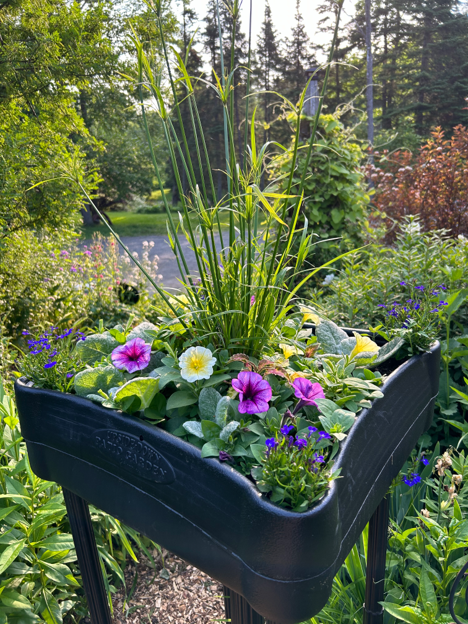
Container gardening is a fast-growing trend. It takes less time and energy than gardening in the soil. Almost anyone with a little space can garden with containers and enjoy fresh tomatoes, or flowers, a shrub, or herbs for cooking. There are containers made from many materials including clay (terra cotta), fiberglass, various metals, hanging baskets in plastic or lined with moss or coir (coconut fiber), wood, resin, hypertufa (a peat cement mixture) to name a few. These come in a great variety of shapes, sizes and colors, sufficient to match the décor of any garden, patio area, front entry or other situation. Almost any object can be made into a planter as long as there is provision for adequate drainage and enough room for potting mix for the roots of the plants.
In the last ten years there has been an explosion in the variety of plant material suitable for container gardens. There are plants with eye catching foliage and flowers in nearly every color, trailing plants with wonderful variegation, and vegetables bred for use in container plantings. Take a trip to a local garden centre and have a look at the palette of colours available.
How to start a container
As the Queen said to the White Rabbit in Alice’s Adventures in Wonderland, “begin at the beginning”. There are three considerations: the plants, the pot and the design. Before designing the planting consider the angles from which the planting will be viewed, the foot traffic in the area, the kinds of plants that can be planted together and the care and watering requirements. The color, form and texture of the plants in the design will play a key role, as will their growing habits.
The real fun comes in visiting places where containers are sold and selecting some. Beware of how much a container weights empty as it will certainly weigh more filled with potting soil and plants. Drainage holes should be present in the bottom of the pot. If this is not the case you can drill them with an appropriate bit. Don’t worry about getting the planting “wrong”. A failing plant can easily be replaced and you will get to do the process again next season. Be sure to match the planting to the pot i.e. a tall plant like a canna lily will require a pot that is 50 cm (20 inches) high and 45 to 60cm (18 to 24 inches) wide. Plants will tolerate some crowding in the pot as long as they are watered and fertilized adequately. Check the plant tags to see how large the plant will become and any needs that it has such as shade or trimming to maintain it shape.
Purchase a soilless potting mix to fill the pots. There are mixes designed for container plantings. The mix can be recycled from year to year. Try not to use. garden soil as it will not drain well in the confines of a container. Plant roots need water but they also need oxygen. Potting mixes are designed to provide proper air exchange in the root area while allowing for adequate drainage.
Now you have a container, plants and potting mix. A few approaches to the design of the plantings are outlined below.
With most containers the thriller (a knockout plant with spectacular foliage or height or flowers), spiller (plants that ramble down over the sides of the container), and filler (plants that compliment the others and provide contrast and make the pot look ‘full’) design approach works well. The thriller should be placed off to one side of centre in the container. The others should be arrayed around it. The amount of plants used should contribute to a full planter “look” early in the season. If the plants have not been outside, set them out to harden off during several dark rainy days, and then plant them in the container. Make sure there is adequate water supplied. Several days after planting, add some transplantation fertilizer.
If the container holds an herb garden remember that most herbs will enjoy a sunny location with well drained soil and good air circulation. One large container will hold oregano, thyme, chives, and spicy globe basil. Regular harvesting for culinary use should keep these plants tidy.
If you want to place a container in a shady location purchase plants like begonias and impatience that do their best in shade. Many coleus plants also enjoy shade. Their foliage comes in many colors and they will punch up the colour in a shade planting.
If the container holds vegetables remember that a deep container is not required for leafy crops like lettuce. Tomatoes, on the other hand, have a long tap root and require a deep container.
Check your container plantings daily to see if water is needed. Care must be taken in watering to ensure that the water lands on the potting soil, not the foliage. Before noon is the best time to water. About every three weeks use a water-soluble fertilizer. If necessary, pinch the foliage plants to make them fuller.
Although the Fredericton Botanic Garden does not usually display many containers, there is usually a container design workshop offered to members and the public. There are also propagation beds which show off plants which may not be incorporated in the display beds. Elevated planters will also be featured in the garden this year.
Sources:
Both Proven Winners and Flower Fields websites provide container planting designs and cultural
requirements for their plants. Many garden magazines put out special editions on container gardening. Examples include Fine Gardening and the Garden Gate. Fine Gardening also has designs on its web site.
In the last ten years there has been an explosion in the variety of plant material suitable for container gardens. There are plants with eye catching foliage and flowers in nearly every color, trailing plants with wonderful variegation, and vegetables bred for use in container plantings. Take a trip to a local garden centre and have a look at the palette of colours available.
How to start a container
As the Queen said to the White Rabbit in Alice’s Adventures in Wonderland, “begin at the beginning”. There are three considerations: the plants, the pot and the design. Before designing the planting consider the angles from which the planting will be viewed, the foot traffic in the area, the kinds of plants that can be planted together and the care and watering requirements. The color, form and texture of the plants in the design will play a key role, as will their growing habits.
The real fun comes in visiting places where containers are sold and selecting some. Beware of how much a container weights empty as it will certainly weigh more filled with potting soil and plants. Drainage holes should be present in the bottom of the pot. If this is not the case you can drill them with an appropriate bit. Don’t worry about getting the planting “wrong”. A failing plant can easily be replaced and you will get to do the process again next season. Be sure to match the planting to the pot i.e. a tall plant like a canna lily will require a pot that is 50 cm (20 inches) high and 45 to 60cm (18 to 24 inches) wide. Plants will tolerate some crowding in the pot as long as they are watered and fertilized adequately. Check the plant tags to see how large the plant will become and any needs that it has such as shade or trimming to maintain it shape.
Purchase a soilless potting mix to fill the pots. There are mixes designed for container plantings. The mix can be recycled from year to year. Try not to use. garden soil as it will not drain well in the confines of a container. Plant roots need water but they also need oxygen. Potting mixes are designed to provide proper air exchange in the root area while allowing for adequate drainage.
Now you have a container, plants and potting mix. A few approaches to the design of the plantings are outlined below.
With most containers the thriller (a knockout plant with spectacular foliage or height or flowers), spiller (plants that ramble down over the sides of the container), and filler (plants that compliment the others and provide contrast and make the pot look ‘full’) design approach works well. The thriller should be placed off to one side of centre in the container. The others should be arrayed around it. The amount of plants used should contribute to a full planter “look” early in the season. If the plants have not been outside, set them out to harden off during several dark rainy days, and then plant them in the container. Make sure there is adequate water supplied. Several days after planting, add some transplantation fertilizer.
If the container holds an herb garden remember that most herbs will enjoy a sunny location with well drained soil and good air circulation. One large container will hold oregano, thyme, chives, and spicy globe basil. Regular harvesting for culinary use should keep these plants tidy.
If you want to place a container in a shady location purchase plants like begonias and impatience that do their best in shade. Many coleus plants also enjoy shade. Their foliage comes in many colors and they will punch up the colour in a shade planting.
If the container holds vegetables remember that a deep container is not required for leafy crops like lettuce. Tomatoes, on the other hand, have a long tap root and require a deep container.
Check your container plantings daily to see if water is needed. Care must be taken in watering to ensure that the water lands on the potting soil, not the foliage. Before noon is the best time to water. About every three weeks use a water-soluble fertilizer. If necessary, pinch the foliage plants to make them fuller.
Although the Fredericton Botanic Garden does not usually display many containers, there is usually a container design workshop offered to members and the public. There are also propagation beds which show off plants which may not be incorporated in the display beds. Elevated planters will also be featured in the garden this year.
Sources:
Both Proven Winners and Flower Fields websites provide container planting designs and cultural
requirements for their plants. Many garden magazines put out special editions on container gardening. Examples include Fine Gardening and the Garden Gate. Fine Gardening also has designs on its web site.
`
`

Heather Connors-Dunphy
Certified Master Gardener
Certified Master Gardener